Wine Glass Rack Spacing: At 2 Inches, Glasses Fall
· 8 min read
As an Amazon Associate we earn from qualifying purchases. We compare what listings and spec sheets actually say, not what the marketing does. Links here may earn us a commission, which never decides what tops a list.
Two Inches Is Where Glasses Start Falling Through
A homeowner on Family Woodworking had a builder cut his under-cabinet stemware slots at 2 inches. He broke a number of glasses trying to keep them up there before he gave up, glued in filler strips to bring the gap down to 1 inch, and reported that afterwards every glass fit and nothing fell through. That single retrofit is the most concrete data point in the sources on wine glass rack spacing, though it brackets the failure point rather than pinning it down.
Wine Enthusiast's published guidance is roughly half an inch to an inch of air between stored glasses, whatever the glass is made of, so bowls don't knock together. Fine as far as it goes. The problem is that it reads like the safe zone continues upward, and it doesn't. In the one reported case, 2-inch slots were too wide to keep glasses in, and narrowing them to 1 inch fixed it. No source narrows the failure threshold further, or ties it to foot diameter.
So what is this piece for?
If you're cutting your own rack, or buying one and trying to work out whether your glasses will actually hang in it, you need to measure your own stemware, because no source publishes the figures for you. Afterwards you'll be able to derive both from the glasses in your cupboard, check a rack's published dimensions against them, and salvage one that's already cut too wide.
The builders don't fully agree, and I won't pretend otherwise. On NC Woodworker the recommendation splits between 3/4 inch and 1 inch depending on who's answering. That's a narrow disagreement, and the one reported failure, 2-inch slots, sits well above both.
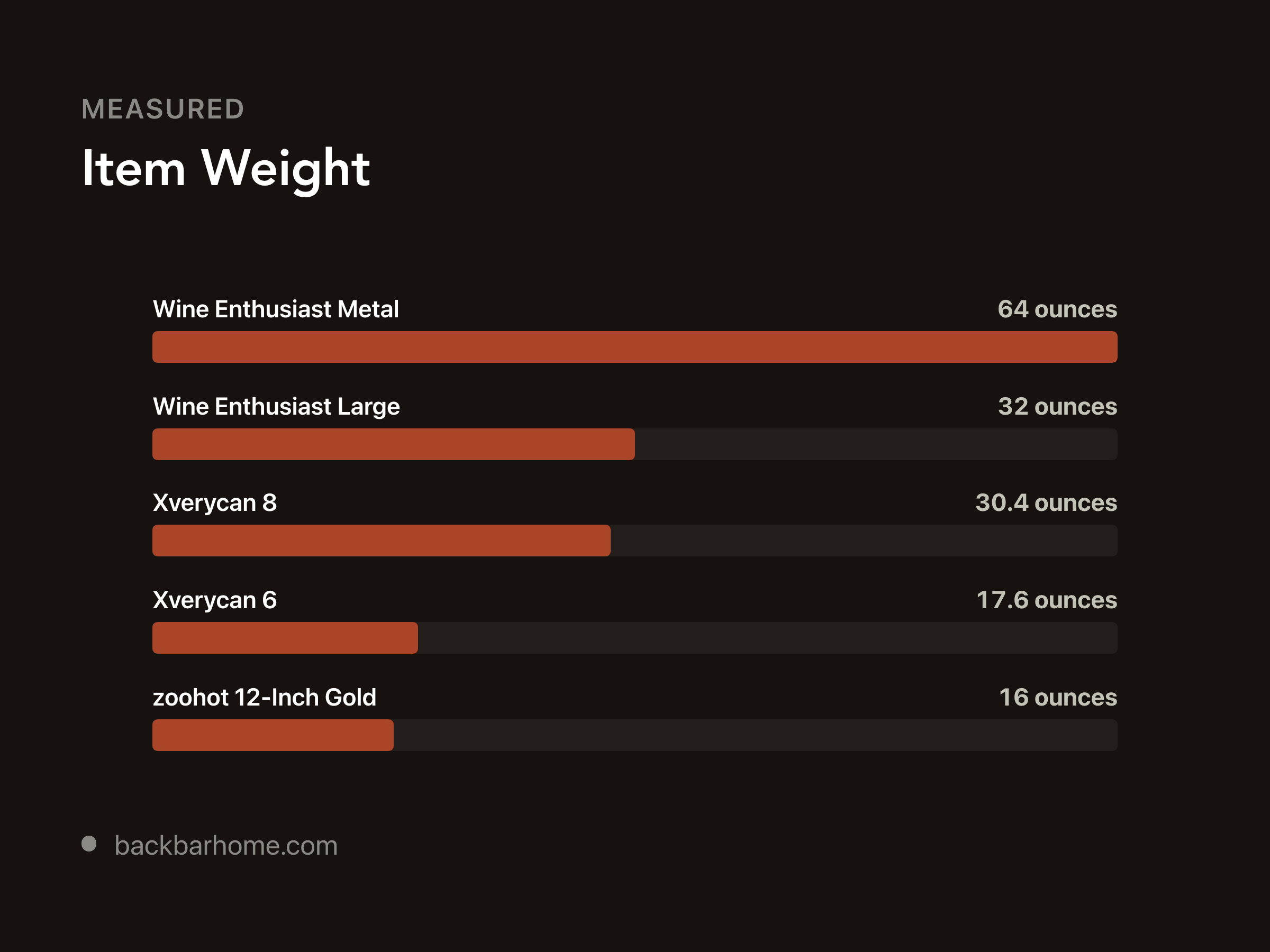
| Product | Product Dimensions | Material | Item Weight | Color | Choose if you need |
|---|---|---|---|---|---|
| Wine Enthusiast Large | 10"D x 25.5"W x 1.5"H | Metal | 2 pounds | chrome | Best large capacity |
| Xverycan 8 | 31.49"D x 2.16"W x 8.86"H | Glass, Metal, Wood | 1.9 pounds | Black | Best widest span |
| Xverycan 6 | 23.62"D x 8.86"W x 2.36"H | Iron | 1.1 pounds | Black | Best mid-size multi-row |
| MATILODI | 15.9"D x 5.11"W x 2.2"H | Iron | 0.35 kg | Black | Best wide openings |
| Great Credentials© | 4.5"D x 10"W x 1.2"H | Stainless Steel | 5 ounces | chrome | Best modular build-out |
| Wallniture Brix | 5"D x 17"W x 1.6"H | Alloy Steel | 8 ounces | Black | Best adjustable spacing |
| zoohot 12-Inch Gold | 12"D x 4.27"W x 2"H | Metal, Wrought Iron | 16 ounces | Gold | Best decorative finish |
| Yimerlen 10.8 | 14"D x 2"W x 2"H | Alloy Steel, Glass, Iron, Metal | 16 ounces | Black | Best published dimensions |
| AQJUNONG | 10.23"D x 4.33"W x 0.86"H | Plastic | 10.8 ounces | Classic White | Best adhesive mount |
| runruii | 10"D x 0.79"W x 4.3"H | Plastic | 300 g | White-2Pack | Best drilling-free |
| Fox Run | 0.75"D x 7"W x 11"H | Wood | 16 ounces | Wood | Best wood finish |
| Wine Enthusiast Metal | 26x13.75x2.75 inches | Metal | 4 pounds | Grey | Best ceiling mount |
Measurements come from the manufacturers. The “Choose if you need” call is ours.
Start here
Wine Enthusiast Large, best for widest single-rail run for long-stem Bordeaux glasses under one deep cabinet.
For everyone else:
- For eight rails across 31 inches when you need max glass count per cabinet bay: Xverycan 8.
- For six rails in under 9 inches of depth for shallow cabinets: Xverycan 6.
- For single 15.9-inch rail for RV or narrow cabinets where only one row fits: MATILODI.
Know this about the Wine Enthusiast Large first: needs a full 25.5 in. of uninterrupted cabinet underside — no modular option for narrow runs
Runner Width and Rail Gap Are Different Measurements
"Wine glass rack spacing" is doing the work of two separate numbers, though no source resolves whether the published figures refer to slot width or to spacing on center. On a slotted rack, the width of each runner board is set by the diameter of the widest glass you own. The gap between boards is the second dimension. No source explains how the two interact: whether widening the gap for larger feet requires wider boards, or whether they can be set independently.
The woodworking advice is more honest about this. Builders on Family Woodworking are told there's no reliable standard opening across manufacturers, and one poster with commercial experience says some makers deliberately avoid it. On NC Woodworker the method is to measure each glass style and add half an inch to an inch on center. Wine Racks America says plainly that there's no right or wrong dimension. Measure your own glasses.
Three measurements to take before you cut anything
Take measurements off your own glasses before a saw touches anything, since every source here says to measure rather than trust a published figure.
- Widest bowl diameter. Measure the fattest glass you own at its widest point. One Family Woodworking builder notes that the board width is set by the diameter of the largest glass, and that bowl girth, as with brandy snifters, has to be accounted for when sizing openings. Stem and foot dimensions alone aren't enough.
- Foot diameter. No source states the minimum gap needed to hold a foot, or ties it to foot diameter, so measure the feet you actually own rather than trusting a published figure.
- The fillet where stem meets base. One NC Woodworker builder rounds over the upper side of the slots to accommodate it, which also cuts down how much hanging glasses sway.
The trap is trusting a published figure instead. The same builder, who says he's cut these commercially, reckons some manufacturers deliberately avoid any standard opening size, so there isn't a number you can look up that covers your cupboard. His own working recipe: a 1x4 each side, roughly an inch of space, the entrance widened slightly, and a stop at the back.
Write the measurements down.
Four-Inch Stock Against Five: The Depth You're Giving Away
Runner width is where depth goes missing. One homeowner's builder reached for 5-inch stock, which cost him a great deal of wasted space. One homeowner on Family Woodworking had his builder use 5-inch boards, then found none of his glasses came close to 5 inches across the bowl. His verdict was blunt: he'd use 4-inch boards if he did it again.
The case for 5-inch stock is that wider glasses need the runners spaced further apart; one builder suggests perhaps 5-inch stock for glasses such as margaritas that won't fit a 4-inch/1-inch layout.
For everyone else it's dead space. A separate builder on the same forum reports 4-inch stock with 1-inch spacing accepting both red and white wine glasses well.
The mixed-collection stagger
If you own both, don't split the difference. Cut 4-inch runners, then put any glass 4 inches or wider into alternate rows so the wide bowls never sit shoulder to shoulder.
Some glasses break the layout outright. Margarita bowls won't go into a 4-inch/1-inch grid at all and need the runners pushed further apart, which is where 5-inch stock earns its keep. Brandy snifters are the other one: one builder notes that stem and foot dimensions are not enough, and the girth of the bowl has to be accounted for when sizing openings.
Can You Save a Rack Already Cut Too Wide?
You can, once, in the one way anybody has written up. One poster on Family Woodworking had a builder cut his stemware slots at a full 2 inches. He broke a number of glasses trying to keep them in the too-wide slots, then retrofitted fillers to bring the gap down to 1 inch. After that, by his account, every glass in the house fit and nothing dropped through.
That is the only documented fix. No source offers a method, material or better alternative for retrofitting an already-cut rack.
It is a compromise, and the homeowner who did it calls the fillers ugly, but by his account every glass then fit and none fell through.
Two things worth doing while you're in there. Put an aggressive roundover on the upper edge of the newly narrowed slot; the NC Woodworker thread notes it accommodates the fillet where stem meets base and cuts down sway. And line the track with adhesive felt, which the same thread notes stops glasses clanking against the wood.
Buying Instead of Building: Which Rack Suits Which Cabinet
Nothing here was measured in hand. One retailer's guidance is that large crystal wine glasses, big Bordeaux glasses, Champagne flutes and oversized bowls often need wider spacing and more clearance than a given holder offers, so glass height, stem length and bowl width should be checked against a rack's measurements before buying.
One rack maker states outright that there is no right or wrong wine rack dimension: it depends on aesthetic preference and storage needs. What the sources do agree on is that a rack should support the stem without putting pressure on the bowl, and that its dimensions should match the glass size.
What the specs look like
For what published product specifications look like: Wine Racks America's wood stemware wall racks hold up to 12 glasses, install between two opposing surfaces with four wood screws, ship fully assembled, and come in three widths, 25 13/16", 34 7/8" and 42 9/16", all 5 1/8" tall, from $190, $210 and $250. Broader retail pricing runs roughly $15 to $25 for under-cabinet racks, $5 to $10 for clip-on racks, $25 to $40 for wooden under-cabinet holders, and $60 to $100 for wall-mounted rack-plus-holder units.
The homeowner with the 2-inch slots got there by retrofitting fillers. If you're buying rather than cutting, the equivalent move is refusing to buy a rack that won't tell you its gap.
Questions
How far apart should wine glass rack rails be?
Builders recommend roughly 3/4 inch to 1 inch of gap between rails. One homeowner whose slots were cut at 2 inches broke several glasses before gluing in filler strips to bring the gap down to 1 inch, after which every glass fit and none fell through. No source publishes a figure tied to foot diameter, so measure your own feet.
What size boards should I use for a wine glass rack?
Runner width is set by your widest bowl, not by a standard. One homeowner's builder used 5-inch stock and wasted depth because no glass came close to 5 inches across; he'd use 4-inch boards instead. A 4-inch runner with 1-inch spacing accepts both red and white wine glasses.
Will margarita glasses or brandy snifters fit a standard stemware rack?
Often not. Margarita bowls won't go into a 4-inch runner with 1-inch spacing at all and need the runners pushed further apart, which is where 5-inch stock earns its keep. Brandy snifters are similar: stem and foot dimensions aren't enough, because bowl girth has to be accounted for when sizing openings.
Sources
- Wine Glass Storage and Racks - Wine Enthusiast accessed 2026-08-03
- Stemware Wine Racks | Holds up to 18 Wine Glasses - Wine Racks America accessed 2026-08-03
- Wine glass rack pattern | NC Woodworker accessed 2026-08-03
- Stem ware hanging rack | Family Woodworking accessed 2026-08-03
- Types of Glass Racks, Sizes, & Materials - WebstaurantStore accessed 2026-08-03
- Wine Rack Height & Size Guide | Wine Racks America accessed 2026-08-03
- Skip to content accessed 2026-08-03