Wine Fridge Noise Level: 38 dB Against Three Rooms
· 10 min read
As an Amazon Associate we earn from qualifying purchases. We compare what listings and spec sheets actually say, not what the marketing does. Links here may earn us a commission, which never decides what tops a list.
38 dB is quiet at 6pm and audible at 11pm
Coolersomm puts the wine fridge industry average at 40 dB, and recommends 40 dB or less for anything going into a kitchen. That's the advice everyone repeats, and Wineandbarrels says appliances rated up to 40 dB are perceived as nearly silent in everyday use. The trouble is what the rule quietly assumes: a busy room with a raised background level, of the sort you get while the extractor fan runs and someone is loading the dishwasher.
At 11pm the same room is far quieter. Nothing about the fridge has changed. But a 38 dB unit is now sitting well above the noise floor. The appliance that was "nearly silent" at dinner is the thing you can hear from the sofa.
So the number is not wrong. It's just measured against the wrong room.
That matters most if your fridge lives in an open-plan space, which is where the bulk of them end up. Wineandbarrels says around 85 percent of the fridges it sells go into a kitchen or family room, with only 15 percent in utility rooms, sheds and basements where nobody is listening. This piece is for the 85 percent. By the end you'll know how to read a dB claim against your own background level, why duty cycle changes the answer more than the rating does, and which of these ten products actually publishes a figure worth checking.
Three of them don't publish one at all.
| Product | Product Dimensions | Capacity | Item Weight | Color | Choose if you need |
|---|---|---|---|---|---|
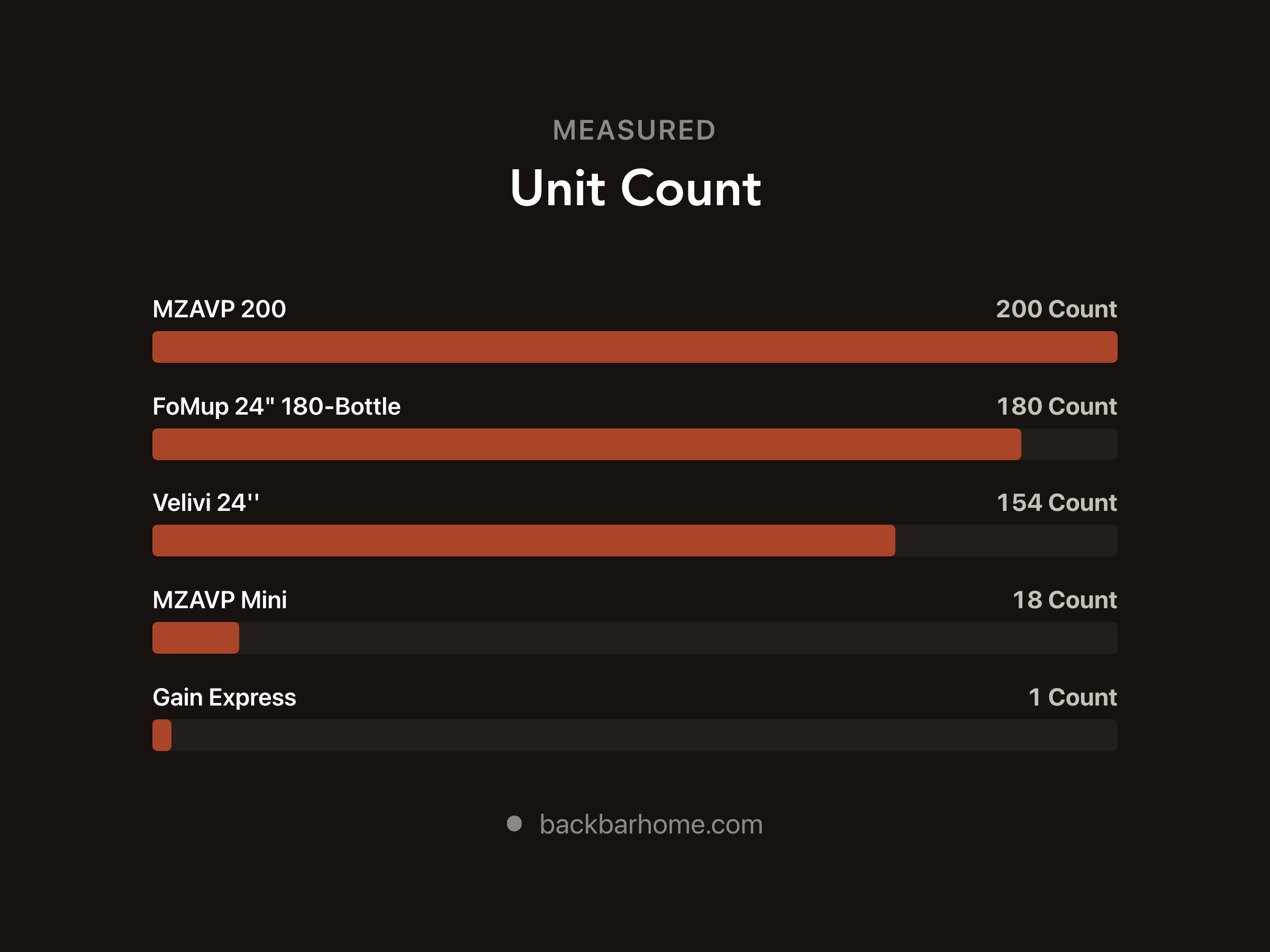
| MZAVP 200 | 27.17"D x 23.54"W x 76.78"H | 16 cubic feet | 170 pounds | 24" Large Daul Zone Wine Fridge | Best large quiet |
| MZAVP Mini | 19.29"D x 13.58"W x 30.71"H | 1.8 cubic feet | 50 pounds | Black | Best small quiet |
| Vushine 12 | 22.84"D x 11.62"W x 34.25"H | 2.2 cubic feet | 58 pounds | Black 20 Bottles | Best narrow built-in |
| FoMup 24" 180-Bottle | 27.16"D x 23.54"W x 65.74"H | 13.5 cubic feet | 216 pounds | Silver Stainless Steel09 | Best reversible door |
| Velivi 24'' | 27.17"D x 23.54"W x 65.74"H | 13.8 cubic feet | 200 pounds | Black08 | Best open-plan venting |
| Wine Fridge | 13.5819.7618.3 | — | — | All-metal Mirror Finish Model | Best compact design |
| Gain Express | 9 x 1.5 x 2.5 inches | — | 7.4 ounces | — | Best for measuring |
| JuviPerpric | 6"W x 2"H | — | 0.24 kg | Black | Best overnight logging |
| ANPIGGY | — | — | 1 pounds | — | Best wall monitor |
| Decibel Meter | 2.28"W x 1.38"H | — | 107 g | Black | Best portable check |
Measurements come from the manufacturers. The “Choose if you need” call is ours.
Start here
Wine Fridge, best for you want a countertop-sized cellar that looks like furniture rather than an appliance, in a room where the compressor will be within a few feet of you.
For everyone else:
- For you want a floor-to-ceiling cellar for a large collection but it lives in an open-plan kitchen, so the published sub-38 dB figure matters as much as the 200-bottle capacity: MZAVP 200.
- For you want the same quoted 38 dB noise ceiling in something small enough for a study, bedroom corner or home office desk return: MZAVP Mini.
- For you have a 12-inch filler gap beside a dishwasher and need a low-noise cooler that can be built in rather than left standing in the room: Vushine 12.
Know this about the Wine Fridge first: no decibel figure and no named brand or manufacturer on the listing
What does the spec number leave out?
Three things, and the first is how it was arrived at:
- The test conditions. No source states how manufacturer decibel figures are measured: which standard, at what distance, in what ambient conditions. So a rating from one brand cannot be verified as comparable to a rating from another. That's the blind spot.
- The arithmetic, which the ranking pages present in two apparently contradictory ways. Coolersomm says each 10 dB step is a tenfold increase in sound intensity. Wineandbarrels says every 3 dB is a doubling, so two 39 dB fridges together read 42 dB, not 78. The two explanations are not reconciled by any source, and neither describes perception.
- Your installation. No source states how rated figures are measured, and none quantifies how much a room adds to them.
No source translates either explanation into what a buyer would actually perceive. Coolersomm puts its quietest EuroCave and Liebherr units at 32 dB, and notes that Climadiff, La Sommeliere and mQuvee now come in under 36 dB. Real gaps on paper, though no source says how much quieter that is in a real kitchen.
What the room adds
Wineandbarrels lists hard surfaces such as tiles, glass and stone among the causes of poor room acoustics, and its technician advises standing the cabinet on sound-absorbing material such as a rubber mat or thick carpet, preferably not on a tiled floor. Coolersomm says an alcove amplifies what the fridge makes. Coolersomm says wine fridges are worse off here than kitchen fridges: glass doors and sleek exteriors insulate less than solid-door refrigerators, and the compressors are smaller and run at higher speeds. If depth is what's forcing you into a tight recess, how deep a beverage fridge can go before built-in becomes the only option is the constraint to settle first.
Duty cycle: the variable nobody puts on the box
Run time is the missing number. A rated figure tells you how loud a unit is while it's running. It says nothing about how much of the evening it spends running, and that second number is the one you actually live with.
No source publishes duty-cycle figures for any model, or quantifies how much placement changes run time, so the trade-off cannot be put in numbers.
Wine and Barrels notes that depending on ambient temperature and how often the door is opened, the fans run most of the time. Coolersomm makes the sharper point: wine fridges cycle their compressors more often than a standard refrigerator does, because holding a narrow band demands it. Beveragefactory says a freestanding unit vents at the rear or sides and needs 2 to 4 inches of clearance at the sides and back, though no source states how clearance or ambient warmth affects duty cycle.
On WineBerserkers, one Vissani 50-bottle owner says theirs is only audible late at night when it cycles on; another describes a built-in Vinotemp as audible every time it cuts off. No source gives the rated decibel figure for either unit, so it is impossible to say whether the spec predicted the complaint.
Measure your kitchen first: three readings and what they mean
Do this before you buy anything.
A rated figure only means something against your own room. No source describes a measurement procedure for a buyer's own room, but two of the sources' observations suggest what to listen for:
- The clap test. Clap loudly and listen for the echo. Wine and Barrels reckons more than about a second of reverberation is experienced as bothersome, and says a low-dB fridge in an acoustically unfavourable room will not be experienced as quiet.
No source offers thresholds for how far a rated figure can sit above a room's background before it becomes bothersome. The products below are judged instead on placement flexibility, whether a decibel figure is published at all, and depth, which is its own problem, covered in how deep a beverage fridge can go before it stops fitting.
Ten products, four criteria
Four criteria decide this, and I applied the same four to all ten items:
- Does the maker publish an actual decibel figure?
- Can the unit be recessed away from ear level?
- How many moving noise sources does it contain?
- What does the listing say about vibration control?
Who publishes a number
MZAVP is the only maker here that commits to one, with both its units, the 200-bottle tower and the 18-bottle mini, listed as operating below 38 dB, according to the manufacturer's own listings. For context, Wineandbarrels says its own coolers run at around 34-46 dB. Everyone else says "low noise" and leaves it there.
Siting freedom cuts the other way. The 200-bottle unit is listed at 76.78 inches tall and 27.17 inches deep, so it stands in the room whatever its rating. The mini is freestanding only. The Vushine 12-inch is listed as rated for built-in use, though no source addresses whether recessing a cabinet makes it louder or quieter, worth reading alongside how deep a beverage fridge can go before built-in stops working. It publishes no dB figure at all. That trade is the whole article in miniature. If you have the gap, take the 12-inch built-in Vushine.
Moving parts. Coolersomm says dual-zone models are typically slightly noisier, and Wineandbarrels attributes this to the extra fans needed to circulate air in both compartments; neither quantifies the penalty. The MZAVP 200 and the FoMup 180 are both listed as dual-zone, while the Velivi 154 and the small units are single-zone.
Vibration. Dunavox lists wooden shelves as a vibration-reducing feature, as does Wine Coolers Empire; Velivi lists slide-out wooden shelves, while the MZAVP mini lists chrome wire racks. No source rates either against a measured figure. Wineandbarrels says the compressor is preferably mounted on a silicone or rubber mount to reduce vibration.
Which suits which, on the listings alone: a published number, MZAVP. Built-in placement, Vushine. Wooden shelves, Velivi. A reversible door, FoMup.
Normal cycle noise versus a fault
Coolersomm and Wineandbarrels both describe several cabinet noises as normal rather than signs of a fault.
- Hissing, loudest in the first few months. Wineandbarrels attributes this to refrigerant passing through a fine nozzle-like injection hole, and says that on a new fridge the hole is narrow, so the hissing is louder than expected during a break-in period of the first few months, then wears off.
- Gurgling or dripping. Coolersomm lists this as part of the defrost cycle and normal rather than a sign of a fault.
- Popping or creaking. Coolersomm attributes this to thermal expansion and calls it normal.
- Clicking. The thermostat cycling on and off, per Coolersomm, and a natural part of the cooling process.
- Noise from an un-level cabinet. Wineandbarrels calls poor levelling the single biggest source of noise, because the liquid level in the compressor goes out of balance and the compressor then runs louder and more often. Check with a spirit level at least 60 cm long. Eyeballing it will not do.
- Compressor contact. Wineandbarrels notes the compressor sits at the bottom rear and is preferably mounted on a silicone or rubber mount, and can make unnecessary noise if it touches something at the back of the cabinet.
What this list is built on: published specifications, manufacturer decibel claims where they exist, and the noise-diagnosis guidance above. I haven't run these fridges in a room and metered them. Nor has Wirecutter, whose wine fridge guide relies on editorial reviews and customer feedback rather than hands-on testing, worth knowing before you treat anyone's noise verdict as measured.
Which brings the 11pm problem back to where it belongs. No source measures the gap between a fridge's rating and a quiet room, or says how much of it any purchase closes. What the sources do recommend is getting the unit level and keeping the back clear, and if you want the number rather than the argument, put a meter on it. The pocketable RISEPRO HT-80A is listed as reading down to 30 dB at ±1.5 dB. Take a reading in month one, and the same reading in month twelve, at the same distance and time of night, though no source addresses whether a wine fridge gets louder over years of service.
Questions
Is 40 decibels loud for a fridge?
Coolersomm puts the wine fridge industry average at 40 dB and recommends 40 dB or less for a kitchen, and Wineandbarrels says up to 40 dB is perceived as nearly silent in everyday use. That assumes a busy room. In a quiet room late at night the same unit sits above the noise floor and becomes audible.
Will I hear a 38 dB wine fridge at night?
Probably, if the room is quiet. Nothing about the fridge changes, but the background level drops, so 38 dB now sits well above it. One WineBerserkers owner reports their Vissani 50-bottle unit is only audible late at night when it cycles on. Duty cycle decides how often that happens.
Why does my wine fridge sound louder than its rated dB?
Wineandbarrels calls poor levelling the single biggest cause: the liquid level in the compressor goes out of balance, so it runs louder and more often. Hard surfaces, an alcove, a tiled floor, and a compressor touching the cabinet rear all add noise. Check level with a spirit level at least 60 cm long.
Which wine fridge noises are normal and which mean a fault?
Coolersomm and Wineandbarrels treat several as normal: hissing from refrigerant through a narrow injection hole, loudest in the first few months; gurgling or dripping during defrost; popping or creaking from thermal expansion; and clicking as the thermostat cycles. Noise from an un-level cabinet or a compressor touching the back is fixable, not inherent.
Sources
- Top 5 Wine Fridge Features - Decibel Level accessed 2026-08-04
- Can anyone recommend a QUIET under cabinet wine fridge? - WINE TALK - WineBerserkers accessed 2026-08-04
- Wineandbarells homepage Showrooms accessed 2026-08-04
- Wine Fridge Dimensions & Size Guide for Every Space | BeverageFactory.com accessed 2026-08-04
- Wine fridge noises accessed 2026-08-04
- The 3 Best Wine Coolers and Fridges of 2026 | Reviews by Wirecutter Advertisement accessed 2026-08-04
- The Ultimate Buyer’s Guide to Choosing the Best Wine Fridge accessed 2026-08-04
- Wine Refrigerator Buying Guide 2026 | How to Choose the Best Wine Cooler - Dunavox Site accessed 2026-08-04