Two Numbers Decide Undercounter Ice Maker Production
· 12 min read
As an Amazon Associate we earn from qualifying purchases. We compare what listings and spec sheets actually say, not what the marketing does. Links here may earn us a commission, which never decides what tops a list.
How much ice does a party actually drink?
Twenty people at a three-hour cocktail party will, by the rule of thumb used below, get through roughly 30 to 40 pounds of ice. Not the 80 pounds your machine is rated for, and not the bin capacity. Somewhere awkwardly between the two, which is exactly why undercounter ice maker production figures mislead people. So the question that decides your purchase isn't whether a machine makes 80 pounds a day. It's whether it can put 60 pounds in front of 20 people inside a three-hour window.
Here's where that number comes from. Start with one drink. As a rough working estimate, a rocks pour takes four or five cubes, call it half a pound of ice with what's lost to melt in the glass, and a guest drinking cocktails gets through two an hour early on, one an hour later. That comes to roughly a pound of ice per guest per hour. An estimate, not a measured figure, since no source here quantifies party consumption.
Beer and wine service is different. There the ice isn't in the glass, it's in the tub, and on the same rough estimate a tub of bottles wants three to four pounds per guest for the whole event regardless of how long they stay. Soft drinks land lowest: big cubes, slow refills, perhaps half a pound per guest per hour. None of these rates is drawn from a published source.
The table below applies those unsourced estimates arithmetically; no source in this set verifies the underlying rates.
Keeponhome's household sizing guidance, 65 to 80+ pounds a day for entertaining or a home bar, answers a question about daily volume rather than one about a three-hour peak.
What follows sets out the criteria that actually decide this, then looks at the published listings for six specific machines. You'll finish knowing which one fits your cabinet, your drinks and your guest count.
| Product | Product Dimensions | Capacity | Item Weight | Included Components | Choose if you need |
|---|---|---|---|---|---|
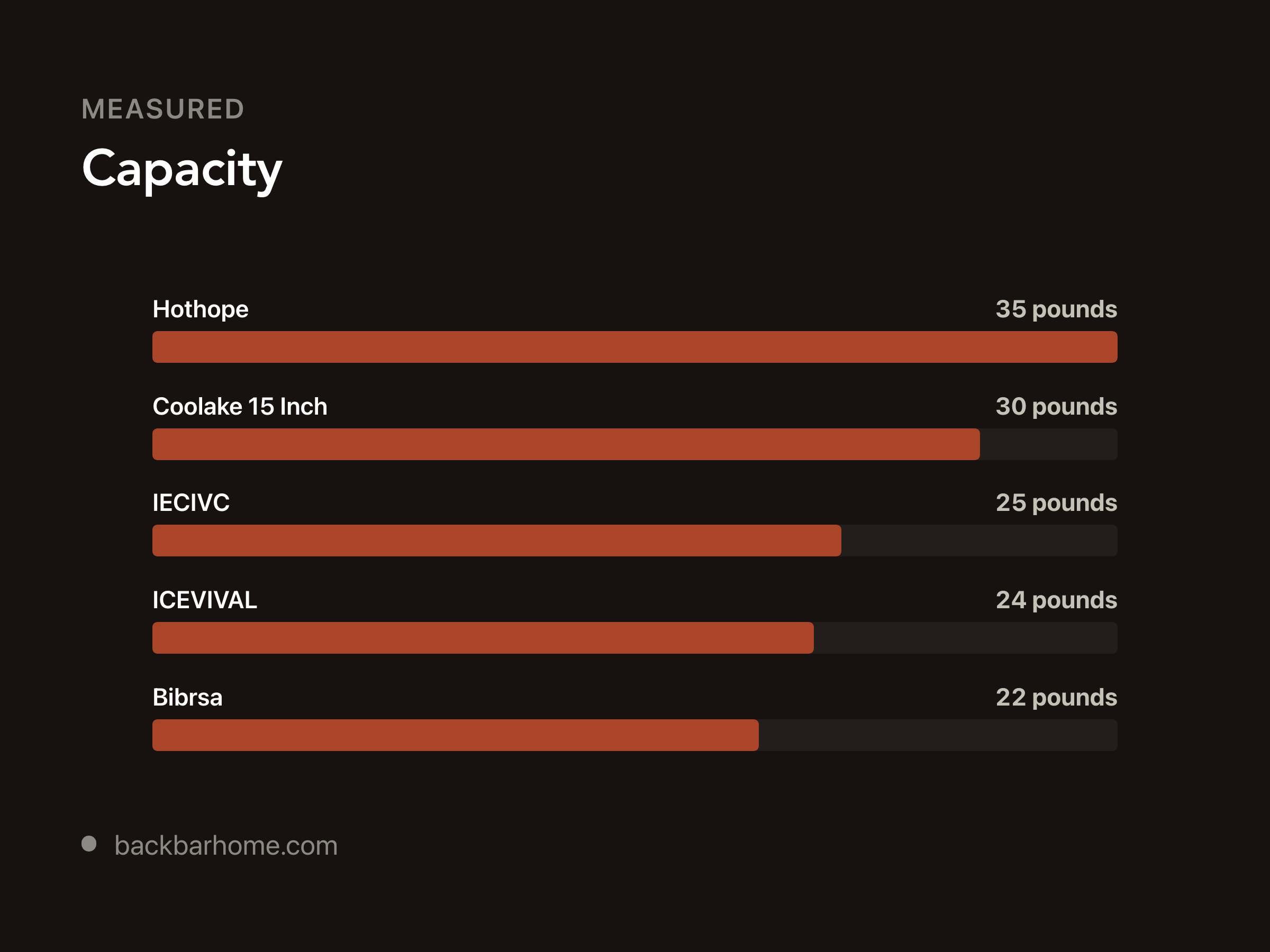
| Coolake 15 Inch | 15"D x 21"W x 33"H | 30 pounds | 60.6 pounds | Removable Ice Bin; Bule Light; Ice Scoop | Best for low counters |
| Hothope | 16.93"D x 14.17"W x 29.92"H | 35 pounds | — | Ice machine | Best highest output |
| ICEVIVAL | 18.5"D x 15"W x 33.46"H | 24 pounds | 57.5 pounds | Ice Maker, Electric drain pump, Water outlet/inlet hose, Ice scoop | Best without floor drain |
| IECIVC | 20.7"D x 14.6"W x 32.9"H | 25 pounds | 71 pounds | Ice Maker Machine, Removable Ice Bin, Water Hose, Drain Hose, Ice Scoop | Best reversible door |
| Bibrsa | 20.5"D x 15"W x 33.2"H | 22 pounds | 25 pounds | 1 | Best scheduled operation |
| Commercial Ice Maker | — | — | — | — | Best fast cycling |
Measurements come from the manufacturers. The “Choose if you need” call is ours.
Start here
Coolake 15 Inch, best for someone fitting an ice maker under a low, ADA-height counter who still wants triple-digit daily output.
For everyone else:
- For a host who wants the highest realistic party output and can leave the machine freestanding on a floor or bar back: Hothope.
- For an installation with no floor drain below the unit, where waste water has to be pushed upward or sideways: ICEVIVAL.
- For a cabinet where the door has to swing the other way and the drain can simply run to a floor drain: IECIVC.
Know this about the Coolake 15 Inch first: 60.6 lbs and 21" wide overall, so it needs a genuine cabinet bay rather than a countertop
The three-hour window, not the 24-hour rating
A party is a burst, not a day. Universal Appliance and Kitchen Center, a Los Angeles appliance dealer, puts typical undercounter output at 20–50 lbs per day, though a competing article gives the residential range as roughly 25 to 80+ lbs. The arithmetic on the low end is unkind. A machine rated 50 lbs across 24 hours averages roughly 2 lbs an hour, so if that pace held evenly across a three-hour peak it would contribute about 6 lbs. No source states that production is evenly distributed across the day, so this is arithmetic on the rating rather than a measured output.
Six pounds. That's maybe a dozen drinks' worth of fresh production over the whole busy stretch.
Everything else comes out of the bin. The retailer quotes the same 20–50 lb range for storage as for daily output, a coincidence the source does not explain, and one that means the figure cannot be read as either alone. On the arithmetic above, most of what guests consume during a short party would come out of the bin rather than from fresh production. The 24-hour number that dominates every product title barely touches the evening.
The two ways you run out
Which spec has failed depends on how you ran out, and the failure modes look different:
- Bin too small. You emptied it in the first hour and spent the night waiting on cycles. That's a storage problem, and no amount of daily production fixes it.
- Production too slow. You banked ice for two days and still couldn't refill between Saturday lunch and Saturday dinner. That's the rating doing its job badly.
Euhomy's buying guide makes the distinction plainly: stated daily pounds describe the machine's long-run pace, while bin size determines how often you have to scoop. Two questions, two numbers.
So the widely repeated advice, size by pounds per day, is right for a café pulling ice steadily from open to close. For a household that entertains twice a month, it's close to the wrong spec. Sizing for a 35 lb insulated bin does more for a Saturday than twenty extra pounds of daily pace ever will.
What does a hot kitchen cost you?
Somewhere between 10 and 20 percent of the rating, and nobody will tell you which. Take a listing claiming 120 lbs a day at its word. Keeponhome says daily output ratings are measured under ideal lab conditions: 70°F ambient, 50°F water. Your kitchen in August is not that room. Keeponhome puts real-world output at 10 to 20 percent below the rating, which is honest as far as it goes and useless as a planning figure, because it doesn't say which end of the bracket you're on.
No source in this set states the ambient temperature at which output actually falls off, or by how much, so there is no basis for tying a specific derating to a 90°F kitchen or an unconditioned garage. The only published figure is Keeponhome's 10-to-20-percent range, and nothing in the set measures it against an actual unit.
That is the honest gap: no source here publishes a derating curve, so the effect of ambient heat and inlet heat cannot be separated.
Two things plausibly help. Front air intake and discharge, which WebstaurantStore notes reduces the installation clearance a machine requires, and keeping the machine out of direct sun with its intake clear. Euhomy makes the same point about refrigeration efficiency holding output steady as the room warms.
Six undercounter machines, rated output against bin
The evidence available here does not cover the six consumer listings discussed below, so their published numbers cannot be verified. That matters more than the ranking order, because the spec that decides whether you run out is the bin, and the bin is the number listings bury under the headline pounds.
Fit comes first
Undercounter units are defined by fitting beneath standard countertop height, which Keeponhome puts at usually 34 to 36 inches. None of these model heights or depths can be checked against the evidence available here. For reference, the residential units the sources do document run to:
- 34.5" high on both the hOmeLabs and Frigidaire models
- 23.4" to 24.5" deep across those same units
- 23.67" high on Kismile's low-cost 80 lb unit, well short of the 34-36" undercounter definition
Which numbers hold up
Among the units the evidence does document, Kismile's 100 lb freestanding model (Z5845A) pairs its 100 lbs/day rating with 33 pounds of storage at 14.6" deep and 15.3" wide, and lists at $333.
Where a listing's headline and its bullets disagree, the lower figure is the safer one to plan against. The wider unresolved problem, on the evidence here, is that no source states a test standard or certifying body for daily ice output, and nothing reconciles commercial ratings of 100-230 lbs/day at 20-24" wide with residential units of similar width topping out near 50-55 lbs.
Drainage is the install decision
Euhomy notes that most built-in ice makers drain by gravity, and Kismile puts the requirement at a drain located within two feet of the ice maker. Euhomy's guide is blunter: if waste water has to rise rather than fall, you need a pump, and that gets planned before the cabinet is set. No source here identifies which models ship with a pump, or what one adds in cost or complexity.
Keeponhome puts residential undercounter draw at 300 to 700 watts while running, costing about $30 to $80 a year. No source ties wattage to output, so efficiency cannot be compared between a 40 lb/day and an 80 lb/day unit.
Bank ice the night before
Take any machine rated well above its bin capacity. It fills the bin and then stops, so leaving it overnight yields a bin's worth of ice, not a day's rating, though no source in this set gives a fill time for any specific unit. To get 60 lbs into the house you have to empty the bin twice before the party starts. The emptying is the whole job.
A working schedule, counting back from the first guest:
- 24 hours out is the earliest useful start. Keeponhome notes that ice held longer than 24 to 48 hours clumps and degrades, so ice banked well in advance is likely to fuse.
- T-minus 20 hours: empty the full bin into freezer bags and stack them in the deep freeze. No source here compares storage methods, so the bagging advice is practical suggestion rather than verified fact.
- T-minus 13 hours: second harvest. No source here gives a bin refill time, so plan this from your own machine's observed cycle rather than a published figure.
- T-minus 5 hours: third harvest if you started early enough. Bank it and let the machine run its last fill into the bin itself.
- Leave the final bin fill alone. That is your working ice, and it is the only ice that has not been handled twice.
One caveat: bins are insulated, not freezers. Euhomy notes that designs which recirculate meltwater extend each fill and help the machine keep pace during heavy use.
Keeponhome puts the recommended cleaning cadence at every three to six months, so there is no need to run it on the day of a party.
Coolake 15 Inch — Best for low counters
- 100 lbs/day rated production with a 30 lb bin, the largest storage in this group
- 33" height and front-breathing vents suit undercounter cutouts under ADA-compliant counters
- But: 60.6 lbs and 21" wide overall, so it needs a genuine cabinet bay rather than a countertop
- But: Listing quotes 3.43 kWh rather than a wattage, making running cost hard to compare
Hothope — Best highest output
- 120 lbs/day and 45 clear cubes per 12–20 minute cycle, quoted as roughly 350 drinks
- Narrowest footprint here at 14.17" wide and 29.92" tall
- But: Curved transparent PC lid suits freestanding use more than a flush built-in cabinet face
- But: 495W is the highest draw in this group
ICEVIVAL — Best without floor drain
- Includes an electric drain pump, so drainage does not rely on gravity
- 24-hour timer plus LCD showing status and ambient temperature
- But: Headline claims 85 lbs/day while the bullet text says up to 80 lbs — the two figures disagree
- But: 24 lb bin is small relative to its output
IECIVC — Best reversible door
- Reversible hinge for left or right door opening
- Published cutout dimensions of 15.06" W x 24.56" D x 34" H take guesswork out of the bay
- But: Heaviest unit here at 71 lbs, awkward to slide into a bay alone
- But: 20.7" deep, so shallow cabinets are out
Bibrsa — Best scheduled operation
- 24-hour timer to start and stop the cycle at chosen times, with an ice-full reminder
- Reversible left or right hinge
- But: Title says 90 lbs/day and 25 lbs storage while the bullets say 80 lbs and 22 lbs — figures conflict
- But: Listed item weight of 25 lbs looks inconsistent with a 20.5" deep stainless cabinet
Commercial Ice Maker — Best fast cycling
- Claims 140 lbs/day with 66 cubes per 8–15 minute cycle, the shortest cycle quoted here
- Runs from tap water or gallon-bottled water, with a water filter included
- But: No dimensions, weight, wattage or voltage published, so undercounter fit cannot be verified before buying
- But: Sold under a generic brand with no model name
So which one should you buy?
Pick by the failure mode you're most likely to hit, not by the biggest number on the box. If you run dry mid-party, the bin was too small. If ice never catches up across a long afternoon, production was too slow. Those are different specs, and most buying advice collapses them into one figure, pounds a day, which answers neither question well.
For a bin-limited household, storage wins. Among the units documented here, bin capacities run from 13 lbs on Kismile's 80 lb unit to 25 lbs on the hOmeLabs and Frigidaire residential models and 33 lbs on Kismile's 100 lb freestanding maker. Keeponhome notes that bins of 25-50 lbs mean fewer refills.
Then the fit cases. Euhomy's advice is to measure the cutout, leave airflow space at the sides and rear, and fit a shutoff valve you can actually reach for service. No source here gives a ventilation clearance in inches for any specific model, so a reader planning a cutout has no published number to work with. Where a drain must rise rather than fall, Euhomy says a compatible pump may be needed and has to be planned before the cabinet is set.
One rule regardless. Euhomy notes that early cycles after installation are small and irregular while the system cools. So a machine installed on event day should be counted on for little more than its bin capacity. Install it well before and let it run.
Questions
How much ice do I need for a party of 20?
On a rough working estimate of about one pound per guest per hour, 20 people at a three-hour cocktail party drink roughly 60 pounds of ice. Beer and wine served in tubs runs higher, near 70 pounds, while soft drinks and mixers use about half that, around 30 pounds.
Is 50 lbs a day enough for an undercounter ice maker?
A 50 lb/day rating averages roughly 2 pounds an hour, so across a three-hour party it contributes only about 6 pounds of fresh ice. Everything else your guests drink comes out of the bin. For entertaining, bin capacity matters far more than the 24-hour production figure.
Why is my new ice maker producing so little ice?
Early cycles after installation are small and irregular while the system cools, so a machine installed on event day should be counted on for little more than its bin capacity. Ratings are also measured at 70°F ambient and 50°F water; real-world output runs 10 to 20 percent lower.
Sources
- The Best Under-Counter Ice Makers of 2025, According to Our Tests accessed 2026-08-04
- Best Under Counter Ice Maker: Top 10 Picks (2026) accessed 2026-08-04
- Undercounter Ice Machine Reviews - WebstaurantStore accessed 2026-08-04
- A Brief Guide to Ice Maker Machines - Universal Appliance and Kitchen Center | Blog accessed 2026-08-04
- Reddit - Prove your humanity accessed 2026-08-04
- Best Ice Maker: Find Your Perfect Match accessed 2026-08-04