Insulated Ice Bucket: Real Ice Retention by Wall Type
· 9 min read
As an Amazon Associate we earn from qualifying purchases. We compare what listings and spec sheets actually say, not what the marketing does. Links here may earn us a commission, which never decides what tops a list.
The four constructions, and what each one actually holds
Two hours into a party the ice has gone to slush, the tongs won't pick anything up, and someone is pouring bourbon over water. That failure has a cause, and it is almost never the freezer. It's the wall of the bucket. An insulated ice bucket buys you time in fairly predictable amounts depending on how it's built, and the four common constructions differ widely in how long they hold ice.
What's at stake is whether you make one ice run or four. If you host for three hours indoors, the cheap double-wall tin is enough and the vacuum premium is wasted; if you serve outdoors in August, the same bucket is empty before the second round. The point of what follows is to let you match construction to event length and put a number on the gap.
The retention figures below come from published guides and manufacturer claims, not from a bench test in this office. Every row assumes the lid stays on and is opened occasionally rather than left off; one guide's cited study puts lid design ahead of material thickness as a driver of performance.
Two things follow. Double wall and vacuum are not synonyms — double wall means an air gap between two stainless layers, vacuum means that air has been evacuated to create a near-vacuum. And Wine-n-Gear's guide says glass conducts heat efficiently and has the fastest melt rates among common bucket types, while acrylic is light, scratch-prone and retains ice poorly.
So the criteria for the rest of this piece: hours of scoopable ice under service, capacity against the crowd, whether meltwater is separated from the cubes, and how the lid seals.
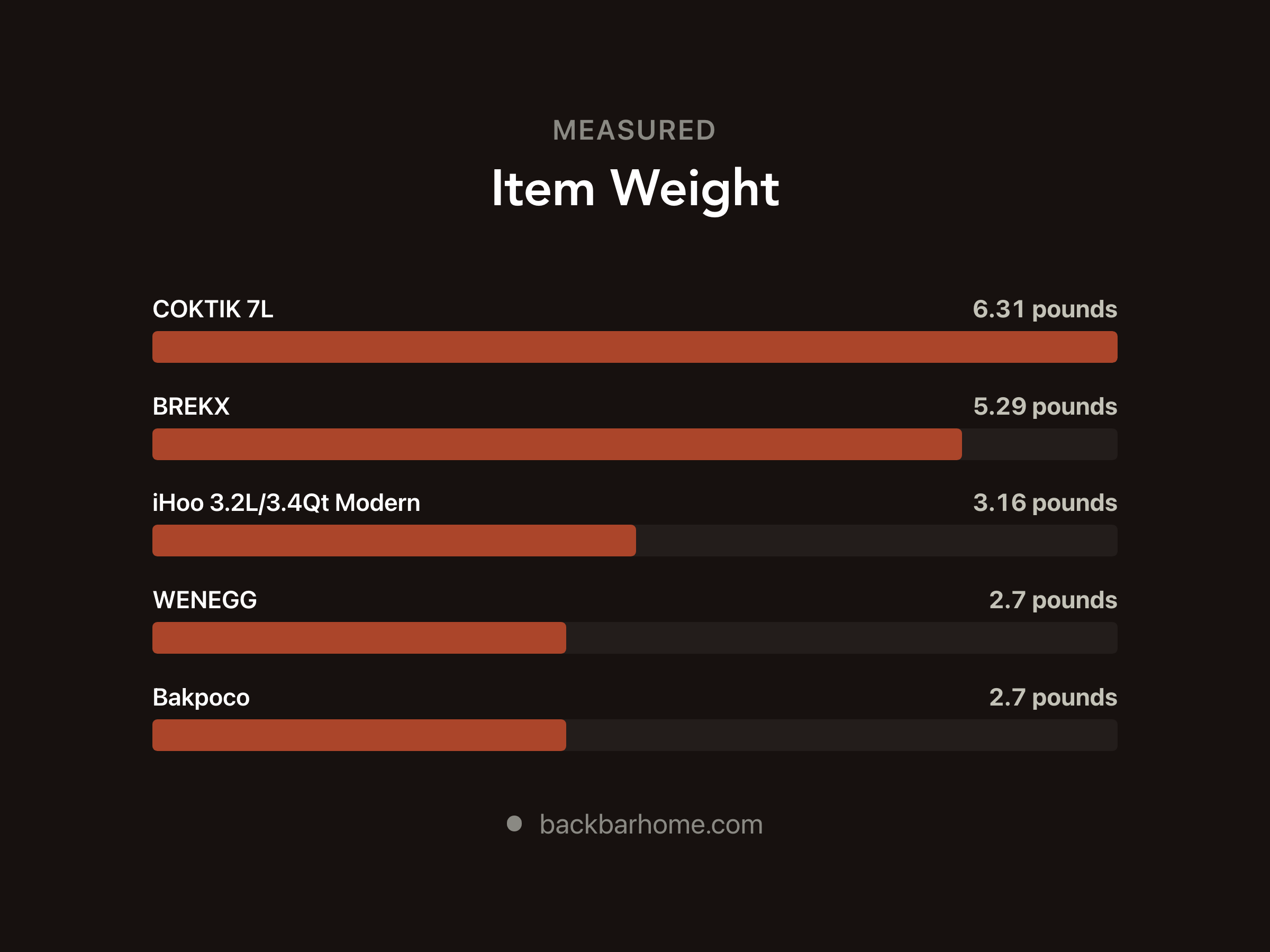
| Product | Product Dimensions | Capacity | Item Weight | Color | Choose if you need |
|---|---|---|---|---|---|
| Oggi | 8"L x 8"W x 8.75"H | 3.8 liters | 2 pounds | Stainless Steel, Black | Best see-through lid |
| BREKX | 13.5"L x 13.5"W x 6.75"H | 9.5 qt | 2.4 kg | Brushed Silver | Best for parties |
| COKTIK 7L | 8"L x 8"W x 8.8"H | 7 liters | 2.86 kg | White | Best for bottles |
| WENEGG | 7"L x 7"W x 6.78"H | 3.17 quarts | 2.7 pounds | Stainless Steel | Best full kit |
| Bakpoco | — | — | 2.7 pounds | — | Best quiet lid |
| iHoo 3.2L/3.4Qt Modern | — | 3.2 L | 3.16 pounds | — | Best countertop look |
| Berverra | 7"L x 7"W x 6.7"H | 3 liters | 2.4 pounds | Silvery | Best for carrying |
| 1.3L | — | 1.3 L | — | — | Best small size |
Measurements come from the manufacturers. The “Choose if you need” call is ours.
Start here
Oggi, best for it is the right answer when whoever is serving needs to see how much ice is left without lifting the lid, and wants the scoop parked somewhere that doesn't drip on the tablecloth.
For everyone else:
- For you are chilling bottles and cans for a crowd and need volume more than you need a long hold time: BREKX.
- For it is the right answer when you need one vessel to hold bottles rather than cubes — six longnecks or three bottles of wine — and want it to double as a hot-food carrier out of season: COKTIK 7L.
- For it is the right answer if you want the full four-piece bar setup in plain brushed steel and want the maker to stand behind it indefinitely: WENEGG.
Know this about the Oggi first: no strainer, so cubes sit in their own meltwater
Why 48 and 60 hours are not lies, exactly
Corkcicle rates its triple-walled stainless ice bucket at up to 48 hours cold, and S'well rates the Ice Bucket XL at up to 60. Neither company publishes the test conditions behind those numbers. S'well describes the construction as 18/8 food-grade stainless with three layers, two of them vacuum-insulated and one of them copper.
What the claims measure is the thing to watch. No source defines what "keeps drinks and ice cold" measures — whether ice is still solid and scoopable, or merely that the contents are below room temperature. Until that endpoint is fixed, the manufacturer hours cannot be compared with the independent ranges above.
The lid assumption nobody writes down
Then there is the condition attached to every one of those hour figures: a lid that stays shut. Alibaba's Lifetips guide cites a 2023 NSF-certified lab study of 47 consumer ice vessels in which lid design accounted for 41% of performance variance, ahead of material thickness at 28% and base insulation at 19%; the guide does not name the study, lab or publication. The same guide reports a side-by-side of 2.8 L vacuum buckets holding 1.0 kg of ice at 21°C in which the gasket-sealed unit had 0.74 kg left after three hours and the open one had 0.19 kg. Same insulation. Three hours. An 81% loss against 26%.
No source states whether the lid was ever opened during the tests behind the 60-hour figure.
Outdoors is a bigger variable than the brand on the lid
Moving the same bucket from a kitchen counter to a patio in July changes its performance substantially. Chang Wen's stainless ice bucket guide puts it plainly: a non-insulated 15L bucket at an outdoor summer party sheds its ice fast, while a double-wall insulated unit keeps ice solid three to four times longer.
Air movement matters too. Alibaba's Lifetips guide cites Chapter 18 of the ASHRAE Fundamentals Handbook for the claim that air movement over an open ice surface increases melt rate by up to 220%. An open beverage tub is therefore a volume decision rather than a retention one.
Refill schedule by construction
Wine-n-Gear's buying guide has single-wall metal and acrylic needing a top-up every 60 to 90 minutes indoors, simply because heat crosses the wall so quickly. Chang Wen is slightly more generous, giving single-wall stainless one to two and a half hours indoors but only 45 to 75 minutes in outdoor summer conditions. Take the harsher number when you're buying ice.
Then translate that into servings. Chang Wen reckons a 3L bar bucket holds a bottle plus ice and covers six to eight cocktails before it needs attention, and Snowfox estimates 40 to 50 servings from a 7L body, assuming half an 8oz cocktail glass of ice per serving.
Three checks for a bucket that has quietly stopped insulating
A vacuum bucket that has lost its vacuum doesn't announce it. It looks identical, weighs the same, and still gets described as insulated on the shelf where it lives. Alibaba's ice bucket guide says degraded units retain ice only 1.4× longer than uninsulated steel. Three checks, none of which take longer than a minute:
- Press the outer wall near the base. The same guide says flex under your thumb, or a faint pop as the metal moves, can indicate a failed vacuum seal.
- Look for condensation on the outside. The Chang Wen buying guide treats beading on a bucket sold as double-wall as evidence the air gap seal is poor;.
- Count the years, not the parties. Alibaba's guide reports that across 1,240 tracked units, well-maintained vacuum buckets had a median service life of 8.3 years while neglected ones lost vacuum integrity at 2.7 years on average; the tracking is not independently documented.
The guide does not say what counts as neglect, or how gradual vacuum loss shows up before total failure.
When the vacuum premium pays, and when it doesn't
A dinner that starts at seven and ends when the last person leaves at eleven is a four-hour job, and Changwen's guide puts double-wall air-gap retention at three to six hours indoors. Changwen's stainless ice bucket buying guide puts air-gap retention at three to six hours at room temperature, against six to twelve for vacuum, with some vacuum units reaching twelve to eighteen in controlled conditions. The same guide prices vacuum construction 25–50% above an equivalent air-gap model.
On those published ranges, a four-hour indoor event sits at the edge of what air-gap construction is claimed to manage, while vacuum construction is credited with more margin. No source tests either construction against a defined service scenario, and none of the retention figures are given for outdoor or direct-sun conditions.
Two honest gaps. The three-to-six and six-to-twelve figures come from one buying guide, not from a lab you or anyone else can inspect, and "room temperature" is doing quiet work in both numbers. And the pre-chill trick that would close some of the gap has a cost: Alibaba's Lifetips guide reports that twelve minutes of pre-chilling an empty, lid-off bucket buys twenty-two extra minutes of usable ice, but says pre-chilling a filled bucket fractures weld seams in 12% of budget stainless units.
Which of these eight suits which situation
Eight buckets, and the deciding question is not which insulates best but what you are putting in it and for how long. Wine-n-Gear's guidance is that ice should fully surround a bottle without overflowing, and cwchangwen's sizing scheme puts 4–6 L in the bottle-chilling bracket — though a competing scheme from Wine-n-Gear puts 4–5 litres in that bracket, and neither is independently tested.
For cube service on a bar, a strainer is the feature to look for: cwchangwen's guide says keeping ice out of its own meltwater keeps it frozen longer, and the same guide notes that included tongs mean no bare-hand contact with ice, a food safety standard in commercial or event settings. The WENEGG ice bucket with lid, scoop, tongs and strainer is one such kit.
Beyond that, the evidence available here contains no specifications for the remaining models, so no claim about their capacity, weight, materials or retention can be made. On materials generally, cwchangwen notes that 201 stainless substitutes manganese for nickel and corrodes sooner than 304, and Wine-n-Gear notes that acrylic retains ice poorly and scratches.
None of these were measured here. This ranking compares what the listings and the manufacturers state, against physics drawn from published sources, and where a listing claims no retention figure this article does not invent one. Which brings the slush back: that two-hour collapse is a wall-construction problem with a bottle-versus-cubes answer, and one guide's cited study puts lid design ahead of material thickness and base insulation as a driver of performance.
Questions
What ice bucket keeps ice the longest?
Triple-wall stainless buckets claim the longest hold — Corkcicle rates up to 48 hours and S'well's Ice Bucket XL up to 60 — though neither publishes test conditions. Among independently ranged constructions, vacuum insulation leads at 6–12 hours indoors, versus 3–6 for double-wall air gap and 1–2.5 for single wall.
What's the difference between double wall and vacuum insulated?
Double wall means two stainless layers with an air gap between them, holding ice roughly 3–6 hours indoors. Vacuum insulated means that air has been evacuated to create a near-vacuum, cutting conduction further for about 6–12 hours. Vacuum construction typically costs 25–50% more than an equivalent air-gap model.
How do I know if my insulated bucket has lost its seal?
Press the outer wall near the base — flex under your thumb or a faint pop can indicate a failed vacuum seal. Condensation beading on a bucket sold as double-wall suggests a poor air-gap seal. Neglected vacuum buckets reportedly lose integrity around 2.7 years, versus 8.3 years when maintained.
Sources
- A Complete Guide to Choosing the Best Ice Buckets | Wine-n-Gear accessed 2026-08-03
- Insulated Stainless Steel Ice Bucket with Lid | CORKCICLE. accessed 2026-08-03
- Best Ice Bucket: Material Science, Thermal Physics & Food Safety Guide accessed 2026-08-03
- Ice Bucket XL accessed 2026-08-03
- Extra Large Ice Bucket with Lid and Ice Scoop, Marble accessed 2026-08-03
- Stainless Steel Ice Bucket Buying Guide accessed 2026-08-03